


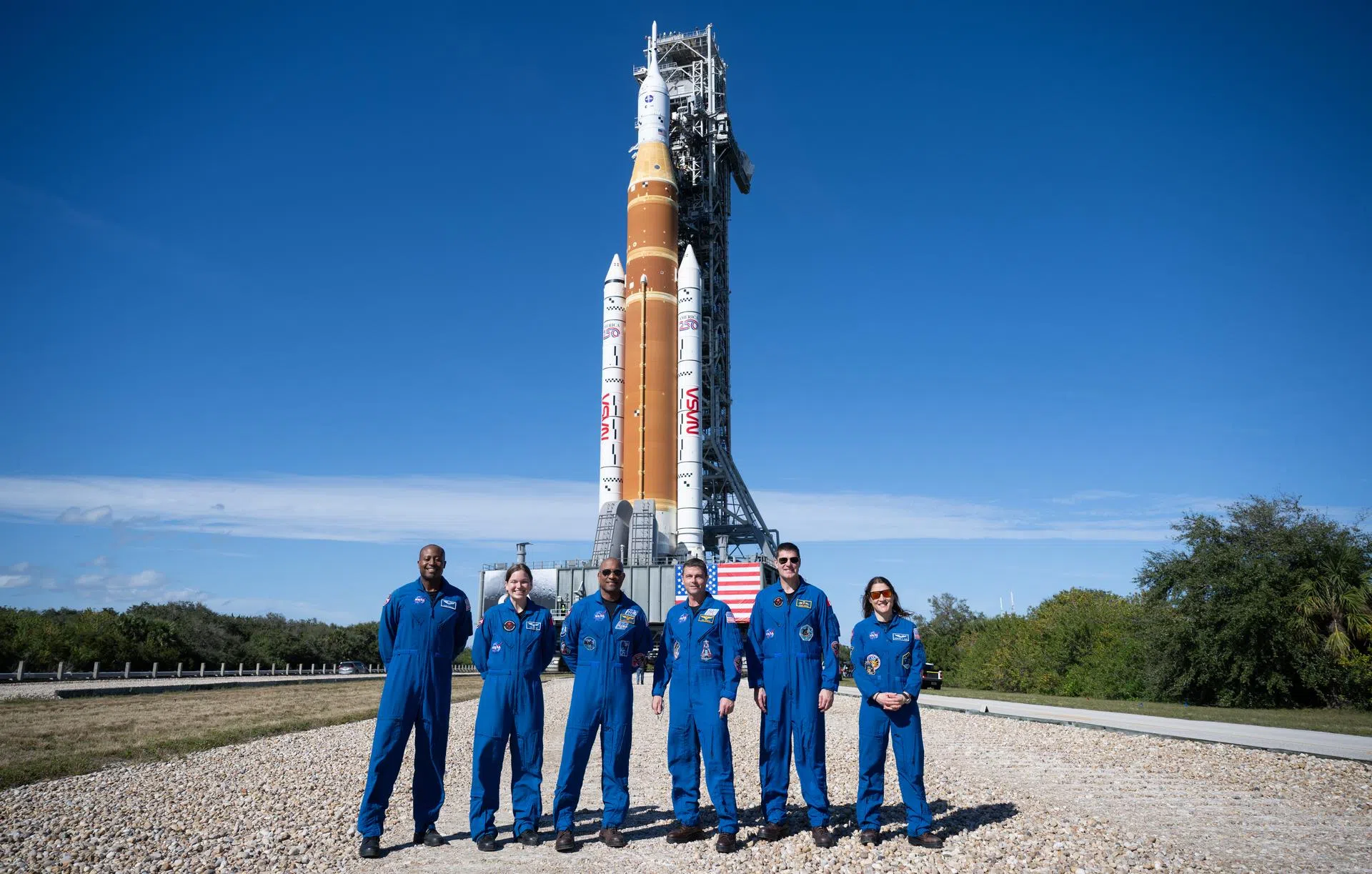
The Artemis II mission, which will launch three Americans and one Canadian around the moon on a ten-day voyage, has been delayed until early March due to a liquid Hydrogen fuel leak.
The mission was slated for February 8, but has now been pushed to the next launch window of March 6 to 11.
The leak was discovered during a “wet dress rehearsal,” when NASA takes the rocket through every stage of the launch process, including fueling and loading the crew, only stopping in the last few minutes before the rocket would liftoff during the real deal.
Canadian Space Agency (CSA) Director of Space Exploration Development Jamie Sevigny says the rehearsal did its job.
“The point of those wet dress rehearsals is really to test everything and to make sure everything is going as planned, and thanks to that, they were able to find some little issues.”
Sevigny says the delay will “give the engineers time to take a look at the data, assess it, analyze it, so that we can have another stab before the second launch opportunity.”
A Canadian space milestone
The Artemis II mission marks the first time since 1972’s Apollo 17, the last moon mission, that a human will venture beyond “Low Earth Orbit,” and fly around the moon.
CSA astronaut Jeremy Hansen is the prime Canadian crew member on the mission, which will make him the first Canadian to voyage to the moon.
“He’s also going to make Canada the second country to send a human around the moon,” says Sevigny, “So this is pretty big.”

CSA (Canadian Space Agency) astronaut Jeremy Hansen, Artemis II mission specialist, participates in a NASA news conference on Aug. 8, 2023, at the agency’s Kennedy Space Center in Florida. (Cropped, via NASA/Kim Shiflett)
Sevigny says the long-running partnership between the CSA and NASA got a Canadian onto the mission.
But she says the most important part was “our contribution of the Canadarm 3, which is a next-generation advanced autonomous robotic system.”
Canada contributed the first-generation Canadarm robotic arm to the Space Shuttle in its heyday, and the second-generation arm to the International Space Station.
The new model robotic arm will eventually be used in the Lunar Gateway, a planned space station orbiting the moon to be built by a large coalition of countries, and meant to support future manned moon missions.
Returning to the moon
The Artemis II is meant to be the first in a series of lunar missions, all building towards a prolonged human presence beyond Low Earth Orbit and eventually towards other planets.
The next flight will be the first time the SLS (Space Launch System) rocket and the Orion crew capsule fly with a human crew.
The Orion will carry its four-person crew around the moon on a “fly-by” over ten days before returning to Earth, gathering data on the function and performance of the vehicle in preparation for Artemis III, which plans to land humans on the moon for the first time since the Apollo program.
To prepare the Orion for its next missions, the crew will test out its ability to manoeuvre.
“They’ll be doing simulations of proximity docking, so they’ll be turning around the Orion spacecraft, looking at the previous stage and seeing if they can line up with it properly,” explains Sevigny.
“They’re really setting up for the next Artemis III mission, making sure that everything’s functioning properly.
The mission will also take advantage of the chance to conduct scientific experiments on human health in space, and practice emergency procedures and crew safety drills.
“They’re trying to jam in a whole pile of things within the limited time that they have for the mission,” Sevingy says.
While the Artemis II mission is not guaranteed to launch in the March window, NASA plans to launch by April 6.